Biotechnology
Explain Like I'm 5
Expert Verified
How Scientists Count Tiny Protein LEGO Pieces in Your Body
3 min read
Mass spectrometry helps scientists count proteins like LEGO blocks in your body. It’s like a super-smart scale for tiny building blocks!
Guess what? Inside your body, there are millions of super tiny workers called proteins. They do everything — like delivering messages, fighting germs, and helping you grow!
But how do scientists see these invisible helpers? And how can they count them? Let’s find out!
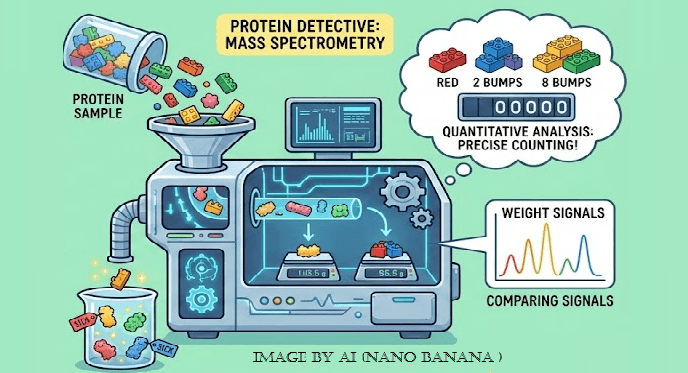
Imagine you have a big box of LEGO pieces. They’re all mixed up — red, blue, big, small, some with 2 bumps, some with 8. Now, imagine you want to count exactly how many of each kind you have.
That’s kind of what scientists do with proteins! But instead of using their eyes, they use a super-cool machine called a mass spectrometer.
Think of it like a super-fast, super-smart scale that can weigh each protein LEGO piece and tell them apart!
At first, scientists just wanted to know: What proteins are here? Like saying, "Hey, there’s a red LEGO piece!"
Now, they want to know: How many red pieces? How many blue? That’s called quantitative analysis — fancy talk for counting stuff precisely.
But proteins are tricky. They’re super small. They break easily. And there are so many kinds in your body!
So scientists had to come up with clever tricks to count them right.
One cool trick is to use tagging, kind of like putting colored stickers on LEGO pieces.
They might tag proteins from sick cells with red stickers and healthy cells with blue stickers. Then they mix them and let the machine count how many red vs. blue appear.
Another way is to compare the weight signals the machine sees — like hearing how loud a drum sounds to guess how many drums are playing.
Each method has its pros and cons. Some are super accurate but take forever. Others are fast but might miss a few pieces.
Even the best detective can get fooled.
Some proteins hide in the mix. Others stick together, so the machine thinks they’re one big piece. And if you don’t prepare your sample just right? Uh-oh — the count could be way off!
That’s why scientists have to be extra careful — like double-checking their LEGO count by sorting twice.
Because counting proteins helps us understand how your body works — and what goes wrong in diseases like cancer or diabetes.
If a certain protein suddenly shows up way more than usual? That could be a red flag — like a LEGO tower growing too tall, telling scientists something’s not right.
Mass spectrometry is like a superhero microscope and scale in one. It helps scientists explore the proteome — that’s the full list of protein LEGO pieces in your cells.
And the coolest part? We’re getting better at it every day!
So next time you build with LEGO, remember: scientists are doing the same thing — just way tinier!
This article has been reviewed by a PhD-qualified expert to ensure scientific accuracy. While AI assists in making complex research accessible, all content is verified for factual correctness before publication.
AlphaFold: Revolutionizing Protein Structure Prediction
AlphaFold achieves atomic accuracy in protein structure prediction, transforming structural biology and bioinformatics.
AlphaFold's Quest: Accurate Protein Structure Prediction
AlphaFold cracks the 50-year protein folding mystery, predicting 3D structures with atomic accuracy in minutes—revolutionizing biology, drug discovery, and structural bioinformatics.
How AlphaFold Solved the Protein Puzzle in Minutes?
Scientists built a smart computer named AlphaFold. It can guess the shapes of tiny body builders called proteins super fast!
No comments yet. Be the first to share your thoughts!
Get notified when we publish new articles. No spam, unsubscribe anytime.