Neuroscience
Explain Like I'm 5
Expert Verified
Scientists found that coffee changes the tiny bugs in your tummy to talk to your brain, which might make you feel jumpy or forgetful.
Imagine if your favorite morning drink could secretly chat with your brain through your tummy. That is exactly what scientists discovered when they looked at how coffee affects your gut brain connection. It turns out that learning how coffee affects your gut brain connection explained simply is really cool because it changes the tiny bugs living in your belly, which then changes how your brain works.
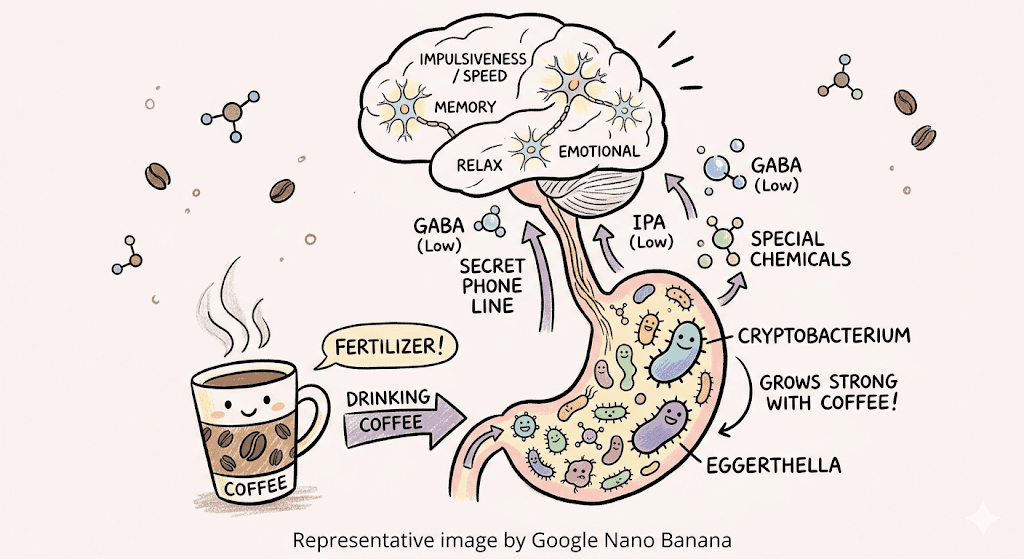
Imagine your tummy has a secret phone line to your brain. Scientists found that drinking coffee changes the tiny bugs living in your gut, which then changes how your brain works. Drinking coffee changes more than 9 special chemicals in your body that talk to your brain, making you feel different than people who do not drink coffee.
Scientists looked at 31 people who love coffee and 31 people who do not drink it at all. They used a super cool machine to count the tiny bugs, or microbes, in their poop. They found that the coffee drinkers had way more of specific types of bugs named Cryptobacterium and Eggerthella. It is like coffee acts as a special fertilizer that helps these specific bugs grow big and strong in your tummy garden.
These bugs are chatty. When coffee drinkers had more of these bugs, scientists noticed lower levels of some important chemicals, like one called GABA that helps calm your brain, and another called IPA that is usually really good for you. This shows us that the coffee is not just waking you up, but it is totally changing the neighborhood inside your gut.
Just like when we learned about how sugar affects our energy, this shows that food talks to our bodies in sneaky ways. The scientists found nine key chemicals floating around in the coffee drinkers that were directly linked to these changing bugs and how well their brains were working.
This is the really interesting part. The scientists asked everyone questions and played memory games with them. They found that the people who drank coffee regularly were more impulsive, meaning they might act fast without thinking, and they had bigger emotional reactions to things. But, the people who did not drink coffee actually did better on the memory tests.
It gets even weirder when they took the coffee away for 14 days. When the coffee drinkers stopped having their morning cup, their impulsive feelings went down, and they felt less emotional. When they started drinking coffee again, some people got decaf and some got regular coffee. The people who drank decaf were the ones who got better at memory tests and slept better. The people who drank regular caffeinated coffee felt less anxious and paid attention better. It seems like the caffeine gives you a speed boost, but the other stuff in the coffee helps your brain relax and remember things.
Scientists wanted to know if these changes would stick around forever. They found that when people stopped drinking coffee, some of the chemical changes in their gut actually went back to normal. But, the moment they started drinking coffee again, their tummy bugs changed almost immediately, whether it had caffeine or not.
This means your body reacts super fast to coffee. The study suggests that by looking at someone's gut bugs, scientists might be able to guess if they drink coffee or not. However, scientists are still figuring out exactly how all these bugs and chemicals send text messages to the brain. They also mentioned that they need to study how fast food moves through the body in future tests because that can change the bug findings too.
Coffee changes the types of tiny bugs living in your gut by increasing ones like Cryptobacterium. These bugs change the chemicals in your tummy, which lowers calming ones like GABA, and this affects how your brain works and your mood.
The study found that regular coffee drinkers scored higher on impulsivity tests and had bigger emotional reactions compared to non-drinkers. Non-coffee drinkers actually performed better on memory tests, showing that coffee might change how we remember things.
Yes, scientists found that people who drank decaffeinated coffee improved their memory test scores and even slept better. Regular caffeinated coffee was better for lowering anxiety and improving attention instead.
This article has been reviewed by a PhD-qualified expert to ensure scientific accuracy. While AI assists in making complex research accessible, all content is verified for factual correctness before publication.
Brainless Jellyfish Sleep Like Humans - It Reveals Why Sleep Evolved
New research shows that brainless jellyfish and sea anemones sleep for about eight hours daily to repair DNA damage in their neurons, suggesting sleep evolved over 600 million years ago with the very first nerve cells rather than with complex brains.
How Coffee Reshapes Your Gut, Brain, and Mood – New Study Reveals
Your daily brew changes your gut bacteria and brain chemistry. Here's what the new science reveals about coffee metabolism.
How Coffee Rewires Your Gut and Brain - Beyond Caffeine
This coffee microbiota gut brain axis cognition study reveals that habitual consumption shapes gut bacteria and behavior. Coffee drinkers showed increased Cryptobacterium and Eggerthella species but reduced levels of the neurotransmitter GABA.
No comments yet. Be the first to share your thoughts!
Get notified when we publish new articles. No spam, unsubscribe anytime.