Genetics
Podcast Host
Expert Verified
Your Brain’s Nightly Deep Cleaning
3 min read
Sleep isn’t just for dreams—your brain is busy taking out the trash.
Hey everyone!
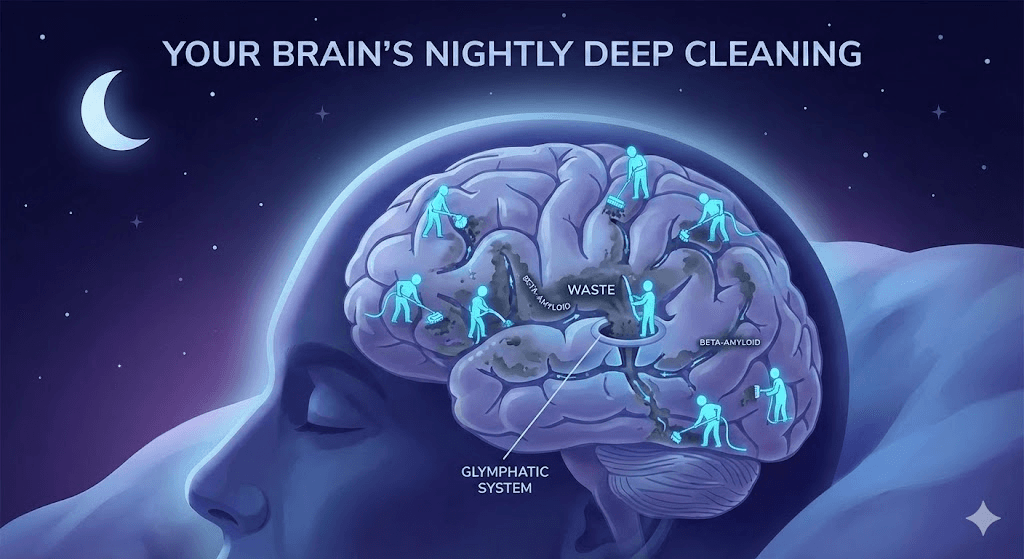
So, I was reading this paper, you won’t believe this: while you’re asleep, your brain is doing something like a deep-cleaning power wash. Like, imagine hiring a crew to scrub down your house every night while you’re passed out. That’s kind of what’s happening up there.
You know how we all know sleep is important? But honestly, if someone asked you why, you’d probably say something like, 'It helps with memory,' or 'I feel better.' And that’s fair. But here’s the thing: for decades, scientists have been stumped by the real, biological purpose of sleep. Like, why would evolution demand we spend a third of our lives unconscious, defenseless, and not reproducing? There’s got to be a good reason.
And now, I think we’re closer to an answer.
Your brain burns energy like crazy. It’s only 2% of your body weight, but it uses 20% of your energy. And just like any engine, that activity produces waste. One of those waste products? Beta-amyloid — you might recognize that name. It’s the sticky protein linked to Alzheimer’s disease.
But here’s the weird part: the brain doesn’t have lymphatic vessels — the body’s normal trash-disposal system. So how does it clear out the junk?
Enter: the glymphatic system.
Let me tell you something — that name is kind of genius. It’s a mashup of glial cells (a type of brain cell) and lymphatic. And it acts like a plumbing network that flushes cerebrospinal fluid (CSF) through the brain, picking up waste as it goes.
But here’s the kicker: this system mostly runs at night — during sleep.
Scientists used two-photon imaging — basically, a super-powered microscope — to watch this process in live mice. They tracked how fluid moved through the brain when the mice were awake, asleep, or under anesthesia.
And what they found was mind-blowing.
During sleep, the space between brain cells expands by 60%.
That extra room lets CSF flow in like a tidal wave, sweeping out waste.
Beta-amyloid? Cleared twice as fast during sleep.
When the mice were awake? The flow dropped by nearly 95%.
Like, imagine turning on a garden hose versus a firehose. That’s the difference between being awake and asleep.
Let me put this another way: every time you pull an all-nighter, you’re basically skipping the brain’s nightly trash pickup. And trash piles up.
You know that groggy feeling after bad sleep? Or the brain fog during a cold? It might not just be fatigue — it could be literal toxic buildup.
And long-term? Chronic poor sleep is linked to Alzheimer’s, Parkinson’s, and other neurodegenerative diseases. This study might explain why: no sleep = no clean-up = toxic proteins hanging around, gumming up the works.
Even anesthesia triggered the same flush effect — which makes sense, since it mimics deep sleep.
So here’s the takeaway: sleep isn’t just ‘rest.’ It’s active maintenance. It’s your brain’s only chance to take out the trash.
And honestly? That makes hitting snooze feel a lot more heroic.
Next time you’re tempted to stay up late scrolling, think about it: your brain’s janitorial crew is waiting for you to turn off the lights.
What do you think — are you giving your brain the clean it deserves?
This article has been reviewed by a PhD-qualified expert to ensure scientific accuracy. While AI assists in making complex research accessible, all content is verified for factual correctness before publication.
CRISPR-Cas9 Allele-Specific Trisomy 21 Chromosome Elimination in Human iPS Cells
A 2025 study used allele-specific CRISPR-Cas9 to eliminate the extra chromosome 21 from Down syndrome iPS cells, achieving a 30.6% karyotype correction rate in clones, outperforming non-specific methods and restoring gene expression linked to nervous system development.
CRISPR Gene-Edited Islet Cells Survive 12 Weeks Without Immunosuppression in Type 1 Diabetes Patient
Gene-edited islet cells survived 12 weeks in a type 1 diabetes patient with zero immunosuppression drugs, using CRISPR-Cas12b to achieve 100% HLA-II depletion.
Why Your Body Fights to Regain Lost Weight
Turns out, fat cells remember obesity in their DNA. Here's what that means for weight loss.
No comments yet. Be the first to share your thoughts!
Get notified when we publish new articles. No spam, unsubscribe anytime.