Medicine
Academic Lite
Expert Verified
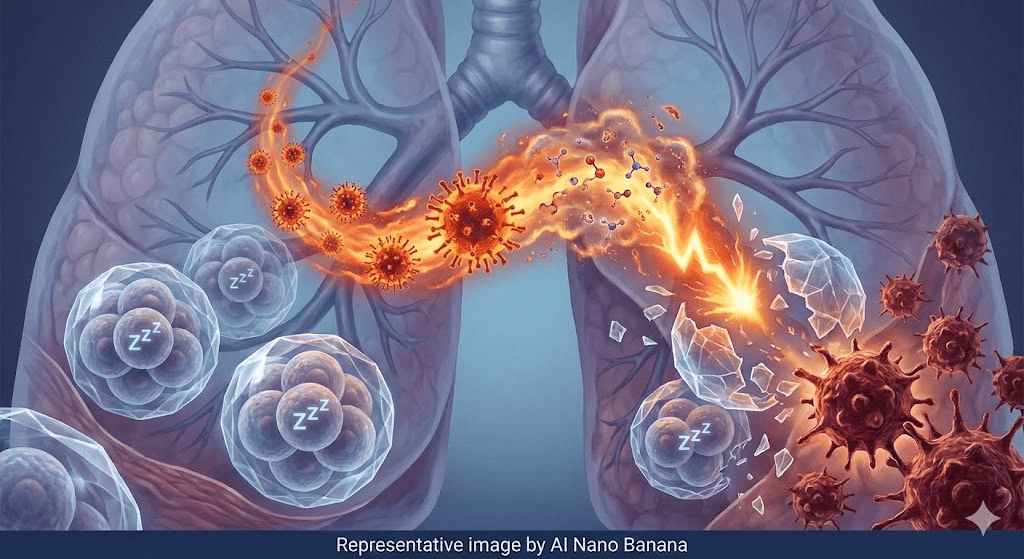
Recent research reveals that common respiratory viruses like influenza and SARS-CoV-2 can "wake up" dormant cancer cells in the lungs through inflammatory signals, particularly IL-6, transforming them into active metastatic lesions within weeks.
Grab a coffee. Let's talk about something that bridges infectious disease and oncology in a way that might surprise you. We often view cancer remission as a permanent victory, but biologically, it's often a state of dormancy. Disseminated cancer cells (DCCs) can remain silent in distant organs like the lungs for decades. The critical question is: what wakes them up?
Let me break this down. Recent research suggests that common respiratory viruses, such as influenza and SARS-CoV-2, act as a potent alarm clock for these sleeping cells.
Using mouse models that closely mimic human breast cancer dormancy (specifically the MMTV-Her2 model), scientists observed that viral infections trigger a massive phenotypic shift. Within days of infection, dormant cells lost their quiescence. By two weeks post-infection, there was a massive expansion of carcinoma cells into full-blown metastatic lesions.
Here's the fascinating part: this isn't just random chaos; it is mechanistically precise. The transition from dormancy to proliferation is heavily dependent on interleukin-6 (IL-6).
When the virus infects the lung, it triggers a storm of cytokines. IL-6 appears to be the key signaling molecule that disrupts the dormant state. But the complexity doesn't stop there. The researchers found that DCCs actually impair lung T cell activation. Specifically, CD4+ T cells begin to sustain the metastatic burden by inhibiting CD8+ T cells. Since CD8+ cells are the cytotoxic "killers" of the immune system, this suppression effectively allows the cancer to thrive under the radar.
Of course, mouse data is only as good as its human applicability. To address this, the researchers turned to large-scale epidemiological data. They analyzed the UK Biobank and Flatiron Health databases to see if this viral awakening occurs in people.
The evidence suggests it does. The analysis revealed that cancer survivors who contracted SARS-CoV-2 faced a significantly higher risk of cancer-related mortality and lung metastasis compared to uninfected survivors. This risk was highest in the months immediately following the infection, mirroring the rapid expansion seen in the mouse models.
What does this mean for treatment? It suggests that managing inflammation in cancer survivors is just as crucial as treating the tumor itself. The study notes that FDA-approved treatments for severe COVID-19, such as IL-6 receptor antagonists, might offer a dual benefit: fighting the virus and keeping cancer asleep.
However, we must acknowledge the limitations. While the correlation is strong, causality in humans is harder to prove than in controlled mouse studies. Future research must focus on clinical trials to see if anti-inflammatory interventions can safely reduce this risk of metastatic resurgence.
So, while we navigate a world full of viruses, this research offers a compelling reason to monitor respiratory health closely in cancer survivors. The connection between our immune response and cancer progression is more intimate than we previously thought.
Yes, recent research suggests that respiratory viruses such as influenza and SARS-CoV-2 can act as a trigger for dormant disseminated cancer cells (DCCs), particularly in breast cancer models. These infections cause an inflammatory response in the lungs that disrupts the dormant state, leading to rapid cancer cell proliferation and metastatic growth within weeks.
Interleukin-6 (IL-6) is a key signaling molecule released during viral lung infections that drives the transition of dormant cancer cells into active, proliferating tumor cells. Blocking IL-6 or its receptor has been shown in preclinical models to reduce this reactivation, suggesting that existing anti-IL-6 therapies could potentially help prevent infection-induced cancer recurrence.
Epidemiological data from large databases like the UK Biobank and Flatiron Health show that cancer survivors who contract SARS-CoV-2 have a significantly increased risk of cancer-related mortality and lung metastasis, especially in the months following infection. This aligns with findings from mouse models, indicating that the systemic inflammation from the virus may awaken dormant cancer cells.
This article has been reviewed by a PhD-qualified expert to ensure scientific accuracy. While AI assists in making complex research accessible, all content is verified for factual correctness before publication.
The AI Revolution in Drug Discovery: Screening the Human Proteome in a Day
Traditional drug screening is too slow to address the 90% of disease targets lacking treatments, taking years to test the human genome. DrugCLIP's AI framework screens drugs 10 million times faster, processing 10 trillion protein-drug combinations in 24 hours and democratizing access through GenomeScreenDB.
AI Diagnostics Revolution: Cancer, Alzheimer's, and Diabetes
Exploring AI-driven breakthroughs in cancer, Alzheimer's, and diabetes diagnostics, their impact, and future challenges.
Early RSV Infection and Wheezing May Reprogram Child Airways
Researchers discovered that children who experience both wheezing and RSV infection in their first year undergo a "double hit" that reprograms their airway cells, causing them to remain in an immature state with weakened barriers and poor antiviral responses. This finding suggests asthma may result from fundamental changes in how lung tissue develops in early childhood rather than just allergies, potentially enabling early intervention before the condition becomes chronic.
Allestar
Jan 17, 2026
Helo curious mind, I do not think you do need to be scared of a simple flu, this is more like awareness I believe. If you had a cancer before which might be metastasized to distance organs. The relapse might be caused by the virus for defance. So instead of worry this maybe inhibitor of IL6 would be good option to prevent. So doctor in the future can take care of it.
curious mind
Jan 14, 2026
So should we be more scared of a simple flu than????
Get notified when we publish new articles. No spam, unsubscribe anytime.