Medicine
Academic Lite
Expert Verified
Traditional drug screening is too slow to address the 90% of disease targets lacking treatments, taking years to test the human genome. DrugCLIP's AI framework screens drugs 10 million times faster, processing 10 trillion protein-drug combinations in 24 hours and democratizing access through GenomeScreenDB.
Pull up a chair. Let me break this down for you. We often talk about the "druggable genome" in medicine, but did you know approximately 90% of disease targets still lack small-molecule therapies? The bottleneck isn't finding the target anymore; it's finding the molecule that fits it.
Here's the fascinating part: we recently solved the protein structure problem with AlphaFold2. We can now predict the shape of almost any protein in the human body. However, knowing the shape doesn't immediately give us the cure. Existing virtual screening methods, specifically molecular docking, simulate the physics of these interactions. While rigorous, they are computationally prohibitive. We simply cannot screen the entire human genome this way; it would take years.
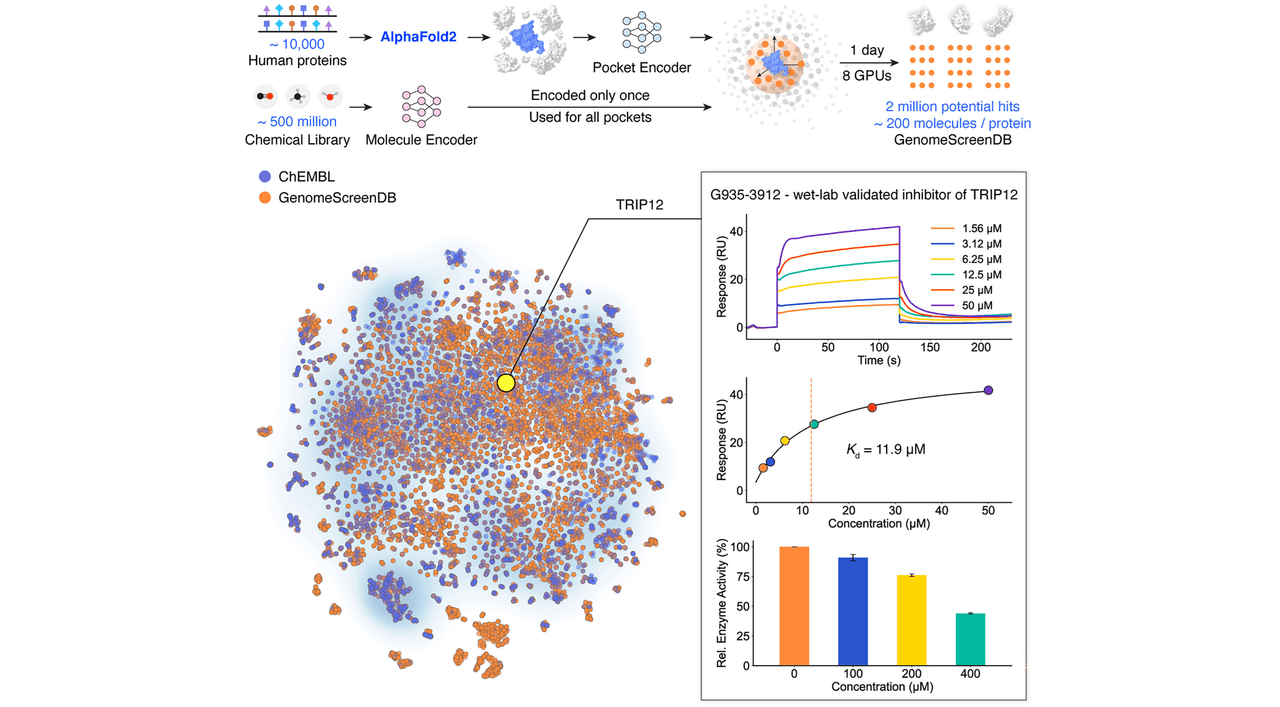
This is where the new research gets exciting. A team introduced DrugCLIP, a framework utilizing contrastive learning. Instead of simulating physics, it maps both protein pockets and small molecules into a shared latent space—essentially a multi-dimensional map where similar items cluster together.
Think of it like translating two different languages into the same mathematical code. If a protein and a drug have similar codes, they likely interact. The evidence suggests this approach achieves ultrafast screening, up to 10 million times faster than traditional docking.
To make this work with predicted structures, they developed GenPack, a generative pocket refinement module. You see, predicted structures can be fuzzy around the edges. GenPack sharpens these "pockets" so the AI can make accurate predictions even without perfect physical data.
But does speed come at the cost of accuracy? The methodology was rigorous. They validated DrugCLIP against standard benchmarks like DUD-E and LIT-PCBA, consistently outperforming other baselines.
The real proof, however, is in the wet-lab validations. For the norepinephrine transporter (a target for depression), DrugCLIP achieved a 15% hit rate. Even more impressive was the work on TRIP12, a target lacking known structures or binders. Using only AlphaFold2 predictions, they achieved a 17.5% hit rate. They even confirmed the binding mode of inhibitors using cryo-electron microscopy.
Let me put this scale into perspective. The researchers applied DrugCLIP to screen ~10,000 human proteins against 500 million compounds. We are talking about scoring more than 10 trillion protein-ligand pairs in under 24 hours.
They released this as GenomeScreenDB, an open-access database. This represents a paradigm shift for the post-AlphaFold era, democratizing access to potential drug candidates for the scientific community.
Of course, we must acknowledge limitations. While the hit rates are high, these are starting points. Further optimization is always needed to turn a "hit" into a "drug." However, the ability to rapidly triage candidates allows researchers to focus resources on the most promising molecules. Future research will likely focus on refining these generative modules to handle even more complex protein dynamics.
DrugCLIP is a computational framework that uses contrastive learning to map proteins and small molecules into a shared latent space, enabling ultrafast virtual screening. By bypassing traditional physics-based simulations, it can predict potential drug-target interactions up to 10 million times faster than conventional molecular docking methods.
To address structural imperfections in predicted protein models, such as those from AlphaFold2, DrugCLIP incorporates GenPack, a generative pocket refinement module. GenPack enhances the quality of predicted binding pockets, allowing the model to make accurate interaction predictions even when starting with less precise structural data.
DrugCLIP has been validated on benchmark datasets like DUD-E and LIT-PCBA, outperforming existing methods. Wet-lab experiments showed a 15% hit rate for the norepinephrine transporter and a 17.5% hit rate for TRIP12—using only AlphaFold2 predictions—confirming binding modes with cryo-electron microscopy, demonstrating its practical utility in identifying novel drug candidates.
This article has been reviewed by a PhD-qualified expert to ensure scientific accuracy. While AI assists in making complex research accessible, all content is verified for factual correctness before publication.
The Viral Wake-Up Call: How Respiratory Infections Reactivate Dormant Cancer
Recent research reveals that common respiratory viruses like influenza and SARS-CoV-2 can "wake up" dormant cancer cells in the lungs through inflammatory signals, particularly IL-6, transforming them into active metastatic lesions within weeks.
AI Diagnostics Revolution: Cancer, Alzheimer's, and Diabetes
Exploring AI-driven breakthroughs in cancer, Alzheimer's, and diabetes diagnostics, their impact, and future challenges.
Early RSV Infection and Wheezing May Reprogram Child Airways
Researchers discovered that children who experience both wheezing and RSV infection in their first year undergo a "double hit" that reprograms their airway cells, causing them to remain in an immature state with weakened barriers and poor antiviral responses. This finding suggests asthma may result from fundamental changes in how lung tissue develops in early childhood rather than just allergies, potentially enabling early intervention before the condition becomes chronic.
No comments yet. Be the first to share your thoughts!
Get notified when we publish new articles. No spam, unsubscribe anytime.