Genetics
Academic Lite
Expert Verified
A 2025 study used allele-specific CRISPR-Cas9 to eliminate the extra chromosome 21 from Down syndrome iPS cells, achieving a 30.6% karyotype correction rate in clones, outperforming non-specific methods and restoring gene expression linked to nervous system development.
Allele-specific CRISPR-Cas9 trisomy 21 chromosome elimination is a gene editing approach that targets and removes a single extra copy of chromosome 21 from trisomic human cells. In this 2025 study, researchers achieved a 30.6% karyotype correction rate in clonal iPS cell lines using 13 targeted cut sites, compared to just 6.8% with non-allele-specific methods. This matters because it demonstrates, for the first time, that precise chromosomal rescue in Down syndrome cells is feasible without silencing or inserting transgenes.
Down syndrome affects roughly 1 in 700 live births and is caused by an extra copy of chromosome 21. For decades, scientists have understood the genetic cause but lacked a practical way to remove that extra chromosome from living cells. This study takes a bold step toward changing that.
Let me break this down clearly. The key innovation here is allele specificity, meaning the CRISPR system was designed to cut only one of the three copies of chromosome 21, not all three indiscriminately.
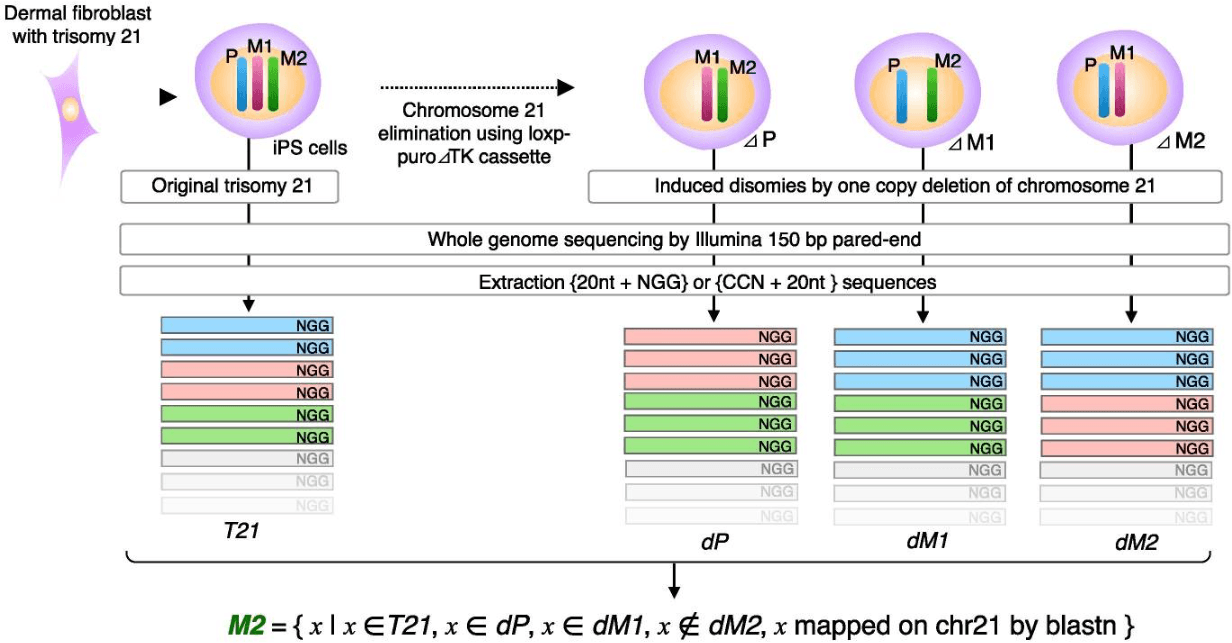
The researchers identified 15,695 Cas9 recognition sequences unique to the target allele (M2), then selected the most effective ones. Using 13 simultaneous cut sites on the M2 allele, the team achieved a chromosome elimination rate of 13.1% (±0.3%) by FISH analysis across all treated cells, rising to 30.6% in established clonal lines.
By contrast, non-allele-specific (ANS) approaches that cut all three chromosome 21 copies topped out at around 8.1% correction and caused dramatically lower cell survival: only 12.7% survival for ANS treatment versus 57.0% for the allele-specific approach. The evidence here is striking. More cuts on the right chromosome outperform more cuts on all chromosomes, and the cells tolerate it far better.
Additionally, temporarily silencing two DNA repair genes (LIG4 and POLQ) using siRNA boosted chromosome loss rates by an average of 1.78 times across all cut configurations, suggesting that cells normally repair and retain broken chromosomes unless that repair window is narrowed.
Here's where the technology behind the experiment becomes fascinating. The researchers worked primarily with induced pluripotent stem cells, or iPS cells. These are adult skin cells that have been reprogrammed back to an embryonic-like state, a technique pioneered by Shinya Yamanaka in 2006 and recognized with the Nobel Prize in 2012.
The beauty of iPS cells is that they can be derived from a specific patient, grown indefinitely in culture, and differentiated into virtually any cell type. This makes them ideal for disease modeling without the ethical concerns of embryonic stem cells. In this study, iPS cells were generated from skin fibroblasts taken from a 1-year-old boy with trisomy 21, giving the team a renewable, patient-specific model to work with.
Critically, the researchers also tested their method on terminally differentiated, nondividing fibroblasts, the original skin cells. The chromosome elimination rate in fibroblasts reached 13.9% (±4.2%), and a 3.2% elimination rate was observed even in cells confirmed to not be dividing. This is significant because most cells in the human body are not stem cells, and any future therapy would need to work beyond the lab dish.
RNA sequencing of corrected iPS cell clones revealed that karyotype rescue restored gene expression patterns associated with forebrain development and neural precursor cell proliferation, two processes known to be disrupted in Down syndrome as early as gestational week 14. The corrected cells also showed reduced reactive oxygen species production and faster doubling times, indicating improved cellular fitness.
This research is a proof-of-concept study, not a clinical trial, and the authors are transparent about its limitations. The entire experiment relied on a single iPS cell line and two cell types, which limits how broadly the findings can be generalized. The study also lacks whole-genome sequencing data across all experimental conditions, meaning some genomic modifications may have gone undetected.
Off-target cutting was observed, though it occurred at on-target loci on the wrong allele due to single nucleotide mismatches, rather than at random sites across the genome. When the target chromosome was not eliminated, the remaining chromosome carried indels and small structural variants introduced by the Cas9 cuts. The authors acknowledge this as a meaningful concern for any future therapeutic application.
Building on earlier CRISPR applications in chromosome engineering, this study points toward several future directions: improving elimination rates, developing delivery systems that work in vivo, and exploring methods that achieve chromosome loss without inducing double-strand breaks at all. Similar research in aneuploidy correction has highlighted the challenge of achieving specificity at the whole-chromosome scale, and this work advances that frontier meaningfully.
The researchers also note that KaryoCreate, a recently reported competing technique using a modified non-cutting Cas9, cannot target chromosome 21 due to the absence of suitable repetitive sequences in its pericentromeric region. The allele-specific cutting approach described here does not face that limitation.
In this 2025 study, allele-specific CRISPR-Cas9 using 13 simultaneous cut sites on the target chromosome achieved a 30.6% karyotype correction rate in established clonal iPS cell lines, compared to just 6.8% with non-allele-specific methods. Cell survival after treatment was also substantially higher at 57.0% for the allele-specific approach versus 12.7% for non-specific cutting. The researchers confirmed that all corrected clones lost specifically the intended target chromosome.
LIG4 and POLQ are key proteins in two major DNA double-strand break repair pathways: non-homologous end joining and microhomology-mediated end joining. When these genes were temporarily knocked down using siRNA, cells were less able to repair the chromosome breaks induced by Cas9, increasing the rate at which the damaged chromosome was lost rather than retained. This boosted chromosome elimination rates by an average of 1.78 times across all cut configurations tested. The knockdown lasted approximately 48 hours, suggesting that this window is the critical period for the cell to decide whether to repair or discard the broken chromosome.
Yes, the study demonstrated chromosome elimination in terminally differentiated skin fibroblasts at a rate of 13.9%, and even in nondividing cells confirmed by EdU labeling, a 3.2% elimination rate was observed compared to 0.4% in controls. However, the study is limited to a single iPS cell line and two cell types, and off-target cuts were detected on nontarget alleles at intended loci due to single nucleotide mismatches. When the target chromosome was not eliminated, the remaining chromosome retained genomic modifications including indels and small structural variants, which would need to be addressed before any clinical application.
This article has been reviewed by a PhD-qualified expert to ensure scientific accuracy. While AI assists in making complex research accessible, all content is verified for factual correctness before publication.
CRISPR Gene-Edited Islet Cells Survive 12 Weeks Without Immunosuppression in Type 1 Diabetes Patient
Gene-edited islet cells survived 12 weeks in a type 1 diabetes patient with zero immunosuppression drugs, using CRISPR-Cas12b to achieve 100% HLA-II depletion.
Why Your Body Fights to Regain Lost Weight
Turns out, fat cells remember obesity in their DNA. Here's what that means for weight loss.
How CRISPR Scissors Remove Extra Chromosomes in Down Syndrome Cells
Scientists used CRISPR gene scissors to remove an extra chromosome 21 from Down syndrome cells, fixing up to 30% of tested cells!
No comments yet. Be the first to share your thoughts!
Get notified when we publish new articles. No spam, unsubscribe anytime.