Genetics
Explain Like I'm 5
Expert Verified
Scientists used CRISPR gene scissors to remove an extra chromosome 21 from Down syndrome cells, fixing up to 30% of tested cells!
Imagine if you could fix a spelling mistake in a giant instruction book by carefully cutting out just the wrong page, leaving everything else perfectly fine. Scientists in Japan just did something amazing like that inside real human cells! They used tiny molecular scissors called CRISPR (say it like "crisper") to remove an extra chromosome from Down syndrome cells, and how CRISPR removes extra chromosomes in Down syndrome cells explained simply is exactly what we are here to explore together.
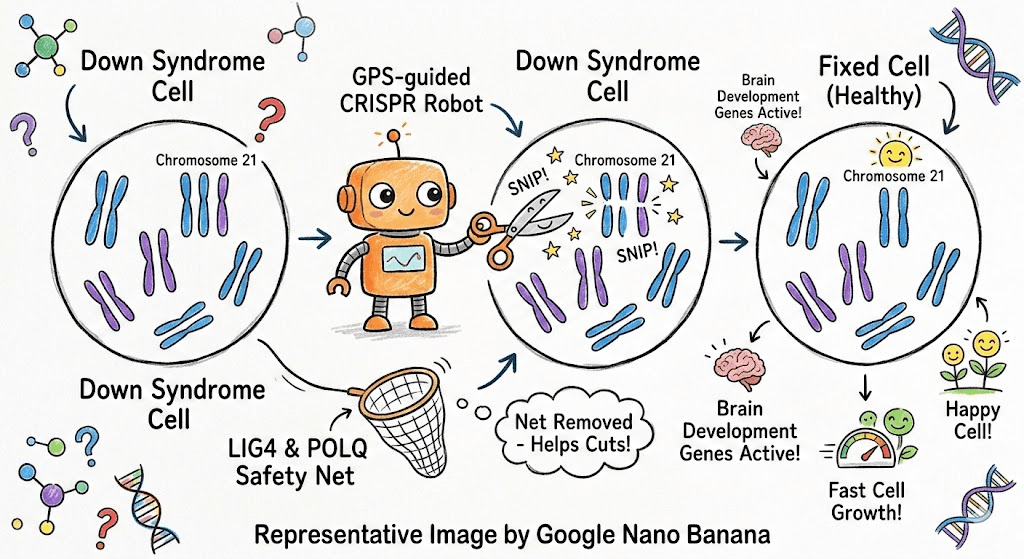
Imagine a tiny robot with super-sharp scissors that can find one specific page in a book made of three billion letters. Scientists built a special version of these CRISPR scissors that hunts down only the EXTRA copy of chromosome 21 in Down syndrome cells. It snipped that chromosome in 13 different spots, and about 30% of the tested cells had their extra chromosome successfully removed. That is what makes this discovery so exciting!
Down syndrome happens because a person is born with three copies of chromosome 21 instead of the usual two. Think of chromosomes like instruction books for your body. Most people have two matching copies of each book. People with Down syndrome have three copies of book number 21.
Scientists used a tool called CRISPR-Cas9, which works like a tiny pair of programmable scissors guided by a RNA (Think of like GPS locating correct location). The tricky part was teaching the scissors to cut only the EXTRA book and leave the other two alone. They did this by finding tiny spelling differences unique to just that one extra chromosome.
When they made 13 cuts in that specific chromosome, about 30.6% of cells lost the extra copy and became normal. Making those cells temporarily forget how to repair DNA damage (by switching off two repair helpers called LIG4 and POLQ) made the scissors work even better, raising the removal rate by about 1.78 times on average!
Here is where it gets really clever. The scientists did not just cut any copy of chromosome 21. They carefully identified which of the three copies was safe to remove, almost like tagging the right book with a sticky note.
This matters because a small number of genes behave differently depending on which parent they came from, a bit like how some family recipes only work when grandma makes them. Cutting the wrong chromosome could cause new problems.
The team also used a special kind of cell called an iPS cell (Induced pluripotent stem cells) to test their method. These are adult skin cells that scientists can "rewind" back to a baby-like state so they can become almost any cell in the body. Invented by Shinya Yamanaka in 2006 (and awarded a Nobel Prize in 2012!), iPS cells let researchers study diseases safely in the lab without needing embryos. In this specific research, scientist used skin cells from a 1-year-old boy with trisomy 21.
After removing the extra chromosome, the rescued cells showed exciting changes. Genes linked to brain and nervous system development became more active. Harmful molecules called reactive oxygen species (which act like tiny rust particles inside cells) went down. Cells even grew faster and healthier!
This research was done in lab cells, not inside a living person, so there is still a long road ahead. Scientists still need to figure out how to deliver this treatment safely into a real human body, how to protect the two good chromosomes from accidental cuts, and whether this works in brain cells and other important cell types beyond skin cells.
The study only tested one cell line from one person, so more experiments with more people are needed. Scientists also want to find ways to remove the chromosome without making any cuts at all, since cuts can sometimes cause small unexpected changes elsewhere in the DNA.
But here is the truly wonderful part: this is the first time scientists showed that cutting a chromosome in a specific, targeted way can fix the karyotype (the full set of chromosomes) in both dividing AND non-dividing human cells. Just like when we learn about other gene editing breakthroughs, each step like this brings scientists closer to turning a laboratory discovery into something that might one day help real people living with Down syndrome.
CRISPR-Cas9 works like a guided pair of molecular scissors. Scientists programmed these scissors to find tiny unique spelling differences on just the extra copy of chromosome 21, then made 13 cuts in it. When a chromosome gets cut in too many places, the cell cannot hold it together and loses it entirely. In the study, about 30.6% of cells had their extra chromosome successfully removed this way.
iPS cells, short for induced pluripotent stem cells, are ordinary adult cells like skin cells that scientists can rewind back to a baby-like flexible state. Once rewound, they can grow into almost any cell type in the body. This makes them incredibly useful for studying diseases like Down syndrome safely in a lab dish without needing embryos. The Nobel Prize-winning technique was invented in 2006 by Shinya Yamanaka.
Not yet. This study was done in lab cells, not inside a living person, so it is still early research. Scientists found that when the extra chromosome was not removed, small unexpected DNA changes were sometimes left behind in the cells. The team also only tested one cell line from one person. Much more work is needed to test safety in brain cells, develop ways to deliver the treatment into a real body, and prevent accidental cuts to the healthy chromosomes.
This article has been reviewed by a PhD-qualified expert to ensure scientific accuracy. While AI assists in making complex research accessible, all content is verified for factual correctness before publication.
CRISPR-Cas9 Allele-Specific Trisomy 21 Chromosome Elimination in Human iPS Cells
A 2025 study used allele-specific CRISPR-Cas9 to eliminate the extra chromosome 21 from Down syndrome iPS cells, achieving a 30.6% karyotype correction rate in clones, outperforming non-specific methods and restoring gene expression linked to nervous system development.
CRISPR Gene-Edited Islet Cells Survive 12 Weeks Without Immunosuppression in Type 1 Diabetes Patient
Gene-edited islet cells survived 12 weeks in a type 1 diabetes patient with zero immunosuppression drugs, using CRISPR-Cas12b to achieve 100% HLA-II depletion.
Why Your Body Fights to Regain Lost Weight
Turns out, fat cells remember obesity in their DNA. Here's what that means for weight loss.
No comments yet. Be the first to share your thoughts!
Get notified when we publish new articles. No spam, unsubscribe anytime.