Biology
News Reporter
Expert Verified
Research finds that sleeping 5.5 hours a night reduces fat loss by 55% during a diet, causing the body to burn muscle instead of fat.
Cutting calories might not be enough if you are cutting sleep, according to a groundbreaking study that confirms sleep restriction reduces diet fat loss efficiency. Researchers at the University of Chicago found that when dieters slept only 5.5 hours per night, their weight loss composition changed dramatically compared to those who slept 8.5 hours. The study reveals that adequate sleep is crucial for ensuring the body burns fat rather than muscle during a diet.
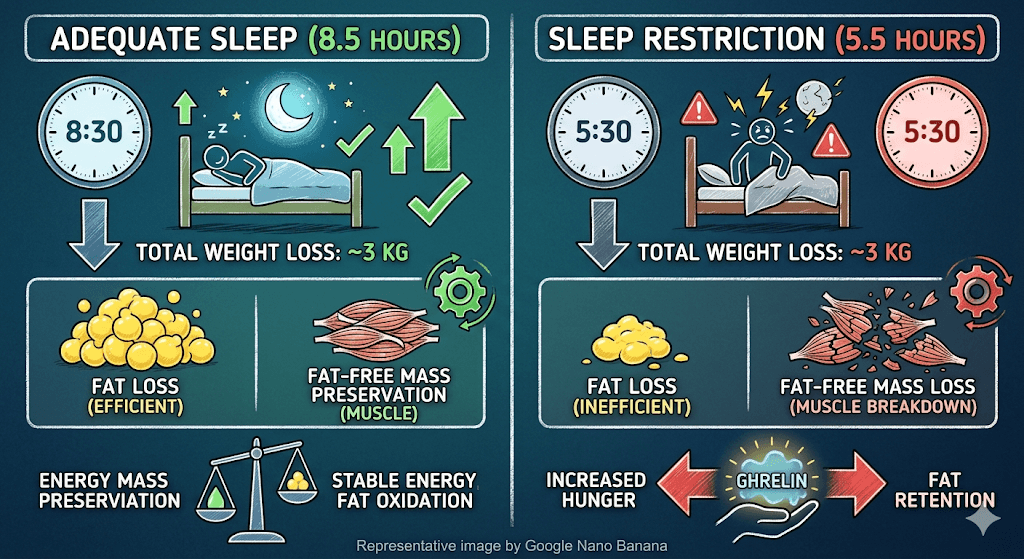
For the first time, a controlled clinical trial has confirmed that sleep restriction reduces diet fat loss efficiency by 55% in overweight adults. Participants who slept 5.5 hours lost only 0.6 kg of fat compared to 1.4 kg in the 8.5-hour sleep group, despite following identical reduced-calorie diets. The study found that insufficient sleep causes the body to lose 60% more fat-free mass, suggesting sleep is critical for preserving muscle while dieting.
The study followed 10 overweight adults in a rigorous two-period crossover design. Each participant spent 14 days on a diet with caloric content restricted to 90% of their resting metabolic rate. They underwent two different sleep conditions, 8.5 hours and 5.5 hours in bed, scheduled months apart to eliminate carryover effects. While total weight loss was approximately 3 kg in both groups, the source of that weight was significantly different. The group with adequate sleep lost more than half of their weight as fat, whereas the sleep-restricted group lost only a quarter as fat.
Researchers discovered that sleep curtailment triggers specific biological mechanisms that sabotage dieting efforts. Sleep restriction increased subjective hunger scores and shifted the body's substrate utilization, causing it to oxidize less fat. This was accompanied by a 24-hour increase in acylated ghrelin, a hormone that stimulates hunger and promotes fat retention. Simultaneously, the sleep-restricted group experienced a significant drop in resting metabolic rate, indicating the body was slowing down to conserve energy.
These findings suggest that sufficient sleep contributes to the maintenance of fat-free body mass during periods of decreased energy intake. The study authors conclude that lack of sleep may compromise the efficacy of typical dietary interventions for obesity and related metabolic risk reduction. The research identifies a catabolic state where the body breaks down muscle for fuel due to sleep deprivation. This follows earlier research on energy balance, highlighting sleep as a third pillar of weight management alongside diet and exercise. The authors acknowledge limitations regarding the small sample size of 10 participants and the controlled laboratory setting, noting that more extensive studies are needed to confirm long-term effects.
Yes, the study found that when sleep was restricted to 5.5 hours per night, the proportion of weight lost as fat decreased by 55% compared to 8.5 hours of sleep. This means dieters burn significantly less body fat when they do not get enough rest.
Participants who slept 8.5 hours per night lost significantly more fat and preserved more fat-free body mass compared to those who slept 5.5 hours. The results suggest getting adequate sleep is essential for maintaining muscle while dieting.
Sleep loss increased hunger and raised concentrations of the hunger hormone ghrelin. It also lowered resting metabolic rate and shifted substrate utilization so the body burned less fat and more lean tissue.
This article has been reviewed by a PhD-qualified expert to ensure scientific accuracy. While AI assists in making complex research accessible, all content is verified for factual correctness before publication.
No comments yet. Be the first to share your thoughts!
Get notified when we publish new articles. No spam, unsubscribe anytime.