Artificial Intelligence
Academic Lite
Expert Verified
Meta's VL-JEPA learns by predicting semantic embeddings instead of generating text token-by-token, allowing it to focus on meaning rather than phrasing. This approach achieves 50% fewer parameters and reduces decoding operations by 2.85x, making it highly efficient for real-time applications like video analysis and smart wearables while matching or exceeding the performance of larger traditional models.
Let's talk about how artificial intelligence currently understands the world. Most modern vision-language models work by predicting the next word in a sequence, a process called autoregressive generation. While effective, it's computationally expensive and often wasteful. Why? Because the model expends massive effort learning surface-level details like word choice and phrasing, rather than focusing purely on the core meaning.
META's latest paper introduces a fascinating alternative called VL-JEPA (Vision-Language Joint Embedding Predictive Architecture). Let me break this down for you. Instead of generating text token-by-token, VL-JEPA predicts the semantic embedding of the answer. It operates in an abstract representation space, allowing the model to focus on task-relevant meaning while ignoring linguistic noise.
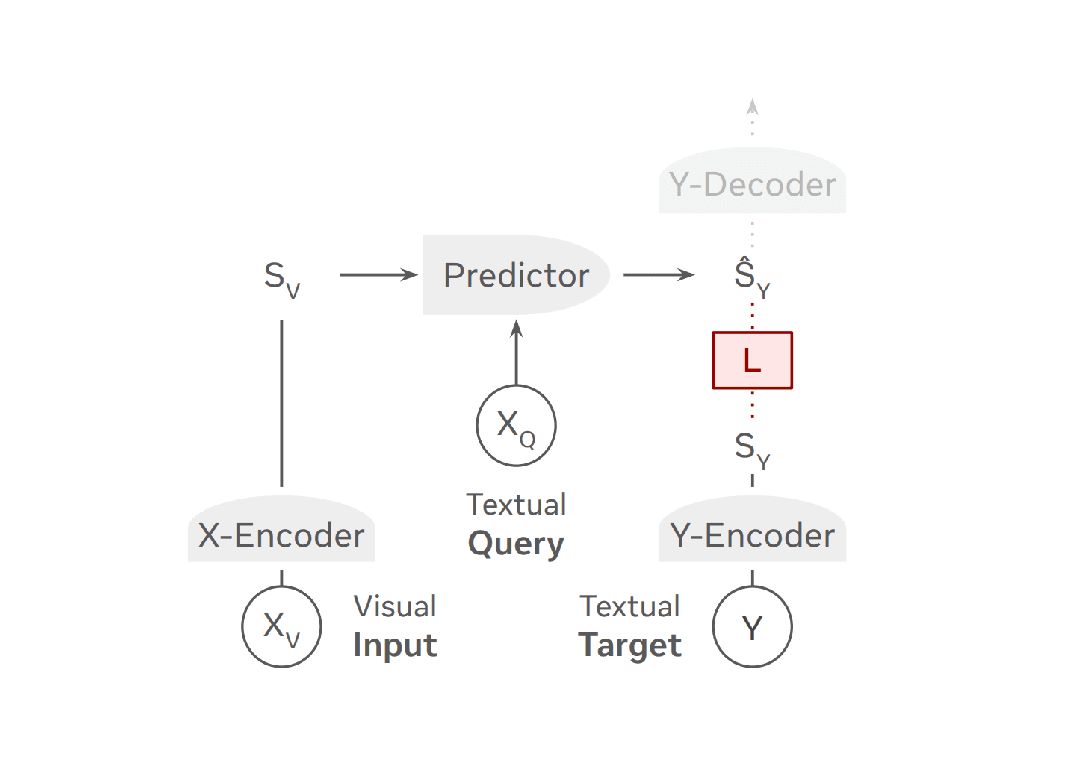
Here is the fascinating part: the architecture is fundamentally different from classical models. VL-JEPA comprises four distinct components working in harmony. First, an X-Encoder processes visual inputs to create compact visual embeddings. Then, a Predictor takes these visual embeddings along with a textual query to predict a target embedding.
Crucially, a Y-Encoder maps the actual text target into an embedding space for training comparison. The loss function is calculated in this embedding space, not the data space. The Y-Decoder—which translates embeddings back into human-readable text—is actually dormant during training and only invoked at inference when necessary. This decoupling is the key to its efficiency.
The evidence suggests that learning in embedding space is significantly more efficient. In a strictly controlled comparison against standard token-space models using the exact same data and vision encoder, VL-JEPA achieved stronger performance with 50% fewer trainable parameters.
Why does this happen? In raw token space, two valid answers like "the lamp is off" and "the room is dark" might look totally different because they share few tokens. However, in the continuous embedding space, these answers are mapped to nearby points because they share the same semantics. The model doesn't need to learn every possible way to phrase an answer, just what the answer actually means.
This architecture has profound implications for real-time applications, such as live video analysis or smart wearable devices. Because VL-JEPA is non-autoregressive, it produces a continuous stream of semantic embeddings in a single forward pass. This enables selective decoding.
Imagine a system monitoring a video feed. Instead of decoding text at every frame, VL-JEPA monitors the embedding stream and only triggers the text decoder when a significant semantic shift is detected. The researchers demonstrated that this approach reduces the number of decoding operations by 2.85x while maintaining performance. This is a game-changer for low-latency AI systems.
Despite being a non-generative model, VL-JEPA performs surprisingly well on generation tasks. It matches the performance of much larger classical models on Visual Question Answering (VQA) datasets while surpassing them on classification and retrieval tasks. Its unified architecture handles everything from text-to-video retrieval to open-vocabulary classification without modification.
Of course, we must acknowledge limitations. This approach is not yet a universal replacement for generative models, particularly in tasks requiring complex reasoning or tool use. However, the methodology represents a significant step toward more efficient, grounded artificial intelligence. Future research will likely focus on scaling this architecture and exploring its potential for multimodal reasoning in the latent space.
VL-JEPA (Vision-Language Joint Embedding Predictive Architecture) is a new model developed by META that predicts the semantic embedding of an answer instead of generating text token-by-token like traditional models. It operates in an abstract embedding space, focusing on meaning rather than linguistic details, making it more efficient. Unlike autoregressive models, VL-JEPA uses a non-generative approach with separate encoders and a predictor, decoupling training from text decoding.
VL-JEPA improves efficiency by learning in a continuous embedding space where semantically similar answers are close together, even if their wording differs. This allows the model to focus on meaning rather than memorizing multiple phrasings. As a result, it achieves better performance with 50% fewer parameters and enables selective decoding, reducing decoding operations by up to 2.85x in video analysis by only translating text when significant semantic changes occur.
VL-JEPA is ideal for real-time applications like live video monitoring and smart wearable devices due to its low-latency, non-autoregressive design and selective decoding capability. It excels at tasks such as visual question answering, classification, and retrieval without architectural changes. However, it is not yet suited for complex reasoning or tool-using tasks, limiting its ability to fully replace generative models in all scenarios.
This article has been reviewed by a PhD-qualified expert to ensure scientific accuracy. While AI assists in making complex research accessible, all content is verified for factual correctness before publication.
The AI Hivemind: Why All Chatbots Sound the Same Now
You’ve noticed it too—AI responses are starting to blend together. Here’s why that’s dangerous.
Prompt Repetition Improves Non-Reasoning LLMs Without Added Latency
Repeating the input prompt improves accuracy across Gemini, GPT, Claude, and Deepseek models in 47 out of 70 benchmarks with zero losses and no added latency.
Anthropic's Assistant Axis: How LLM Persona Drift Causes Harmful AI Behavior
Researchers at Anthropic and Oxford identified a linear 'Assistant Axis' in LLM activation space that governs persona stability. Activation capping along this axis reduced harmful responses by nearly 60% without degrading model capabilities.
No comments yet. Be the first to share your thoughts!
Get notified when we publish new articles. No spam, unsubscribe anytime.