Artificial Intelligence
Explain Like I'm 5
Expert Verified
Scientists made a smarter way to connect parts of AI’s thinking process using mHC so they work better and don't get confused when learning big things.
Picture this: an AI system trying to learn something new, but information gets stuck in traffic jams and bottlenecks inside its brain. Frustrating, right? Well, scientists just built the superhighway to keep everything flowing smoothly!
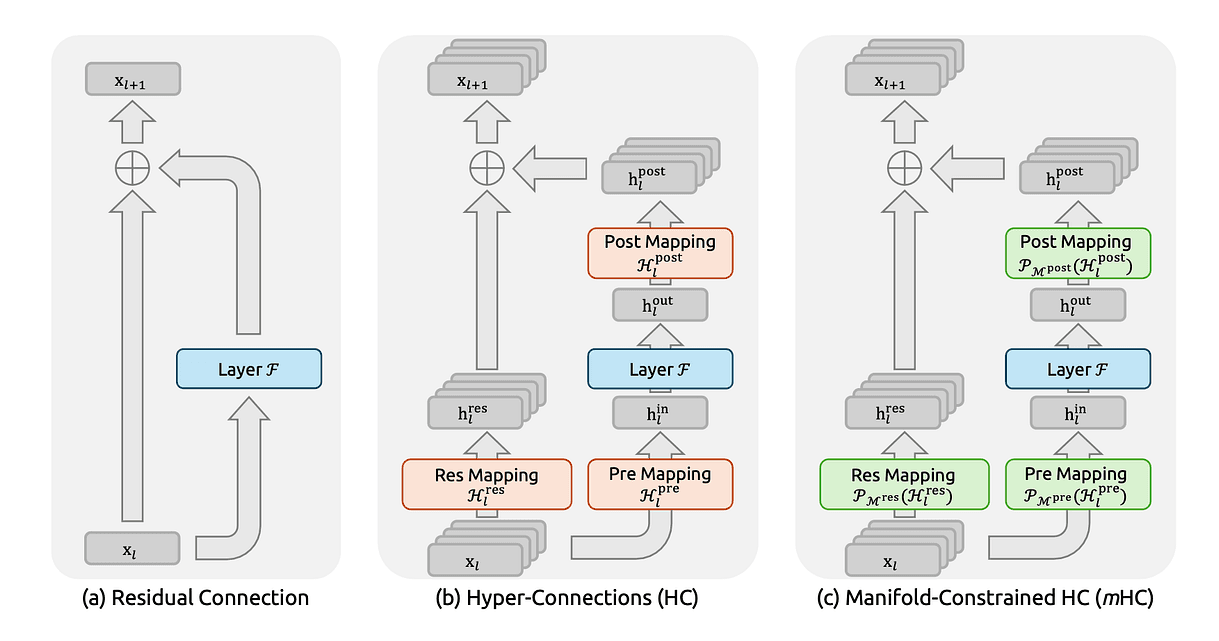
Imagine your brain is made of LEGO blocks. Each block passes messages to the next. In AI, these blocks are called layers, and they talk through something called residual connections—like little bridges that help signals flow smoothly.
This design keeps learning fast and stable. It’s been used in big language models like the ones that write stories or answer questions.
Here's the coolest part about those bridges (residual connections): they have a secret superpower called identity mapping.
Think of it like a copy machine that keeps a perfect backup! While one message goes through the learning layers and gets changed, another copy slides right through unchanged—like a secret tunnel under a busy street. Why does this matter? If the AI gets confused in the learning layers, no problem! The original message is still there, perfectly preserved, waiting at the end. It's like a safety net.
Some smart scientists tried making these bridges (residual connections) upgrading a one-lane road to a multiple superhighway. This idea, called Hyper-Connections (HC), helps AI learn better… at first.
But here’s the problem: they accidentally broke this superpower. Instead of one clean shortcut, the paths all twisted and mixed together—scrambling the perfect backup copy In another word, when the road gets too busy, a chaos breaks loose. Signals either amplify wildly (sometimes over 3000 times too strong!) or fade away completely. It's like a game of telephone gone totally wrong—some messages explode, others vanish. This instability makes training large AI systems unreliable and super slow.
So what’s the fix? Enter Manifold-Constrained Hyper-Connections—or mHC for short. Think of it like traffic cops for the superhighway!
Instead of letting signals run wild, mHC gently guides them using special math rules; "Sinkhorn-Knopp algorithm". It ensures every message stays balanced—like making sure no one shouts too loud or fades away.
It does this by using something called a doubly stochastic matrix (say that three times fast!) a special math rules that say: "Every signal must keep its original strength. No explosions allowed!".
Multiple paths can still share information, but now there's a golden rule: "What goes in must equal what comes out!"
It's like a water park with multiple slides—no matter which slide you take, you end up in the pool with the same splash!
With mHC, AI can grow much bigger without breaking down. It’s like building a skyscraper without the wobble!
Tests show mHC keeps learning smooth, even in giant models. And the best part? It only adds 6.7% more time—that’s barely a coffee break!
Plus, the team made it super efficient with smart coding tricks, so it doesn’t hog memory or slow down.
mHC isn’t just a fix—it’s a new way to design AI brains. It opens doors to smarter, more creative robots and language wizards.
And who knows? Maybe one day, your robot buddy will write poems, solve puzzles, and remember your birthday—all thanks to smarter connections inside!
Isn’t that cool?
Hyper-Connections (HC) can disrupt the identity mapping property that preserves the original input signal during training. When multiple paths are added without proper control, signals either amplify uncontrollably—sometimes over 3000 times—or fade to zero, causing instability and making training large AI models slow and unreliable.
mHC, or Manifold-Constrained Hyper-Connections, uses a mathematical approach called the Sinkhorn-Knopp algorithm to create a doubly stochastic matrix. This ensures that the total strength of all signals remains balanced—what goes in must equal what comes out—preventing signal explosion or disappearance and keeping learning stable and efficient.
mHC allows AI models to scale up significantly in size without becoming unstable, enabling the development of more powerful and intelligent systems. With only a 6.7% increase in training time and efficient memory use, mHC paves the way for smarter language models, creative AI, and advanced robotics.
This article has been reviewed by a PhD-qualified expert to ensure scientific accuracy. While AI assists in making complex research accessible, all content is verified for factual correctness before publication.
The AI Hivemind: Why All Chatbots Sound the Same Now
You’ve noticed it too—AI responses are starting to blend together. Here’s why that’s dangerous.
Prompt Repetition Improves Non-Reasoning LLMs Without Added Latency
Repeating the input prompt improves accuracy across Gemini, GPT, Claude, and Deepseek models in 47 out of 70 benchmarks with zero losses and no added latency.
Anthropic's Assistant Axis: How LLM Persona Drift Causes Harmful AI Behavior
Researchers at Anthropic and Oxford identified a linear 'Assistant Axis' in LLM activation space that governs persona stability. Activation capping along this axis reduced harmful responses by nearly 60% without degrading model capabilities.
No comments yet. Be the first to share your thoughts!
Get notified when we publish new articles. No spam, unsubscribe anytime.