Artificial Intelligence
Podcast Host
Expert Verified
Meta's VL-JEPA represents a shift in vision-language AI by predicting abstract meaning (embeddings) instead of generating text word-by-word, focusing on what something means rather than how to say it. This approach is 3x more efficient because it only converts predictions to text when the meaning actually changes, making it ideal for real-time applications like smart glasses that need to conserve battery while understanding the visual world.
Hey everyone!
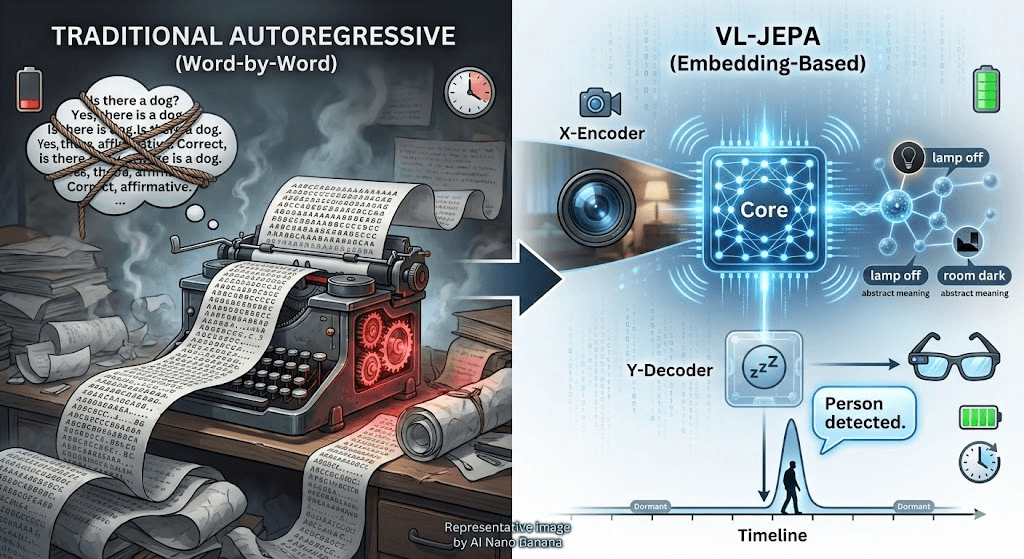
So, I was reading this new paper from Meta’s AI team, the folks led by Yann LeCun—and honestly, it got me thinking about how we usually build artificial intelligence. We often assume Large Language Models (LLM) needs to generate text word-by-word, like a typewriter, but what if that’s actually inefficient?
Here’s the thing: most current vision-language models work autoregressively. That’s a fancy way of saying they predict the next token, then the next, based on the previous ones. It works great for chatting, but it’s heavy. The model has to learn style, grammar, and exact phrasing.
But if you’re asking, "Is there a dog in this video?" you don’t really care if the AI says "yes" or "affirmative" or "correct." You just care about the meaning. All that extra processing for word choice is just wasted energy, you know?
Enter VL-JEPA, which stands for Vision-Language Joint Embedding Predictive Architecture. Let me tell you something, this is a pretty cool shift. Instead of generating tokens, VL-JEPA predicts embeddings.
Think of embeddings like abstract coordinates of meaning in a map. The phrases "the lamp is off" and "the room is dark" might look totally different as text, but in this embedding space, they are neighbors because they share the same semantics.
The structure is actually pretty sleek:
X-Encoder: Handles the visual input (images or video).
Predictor: This is the core. It maps the visual data to a predicted meaning.
Y-Encoder: Processes the target text into an embedding.
Y-Decoder: This sits on the bench! It only wakes up to translate the predicted embedding into readable text when you actually ask for it.
By learning in this abstract space, the model focuses on the gist of what’s happening rather than getting hung up on surface-level details. It’s like reading a summary instead of the whole book sometimes.
This part is wild. Because VL-JEPA separates the understanding from the "speaking," it enables something called selective decoding.
Imagine you’re wearing smart glasses that describe the world around you. An old AI would describe every single frame constantly: "I see a wall. I still see a wall. Still a wall." VL-JEPA, on the other hand, only triggers the text decoder when the meaning actually changes—like if a person walks into the room.
The paper shows this reduces the number of decoding operations by nearly 3x while keeping the accuracy high. That is huge for battery life and speed on wearable devices.
It’s fascinating to see AI move from just mimicking human speech patterns to actually understanding the world more efficiently. This approach uses fewer parameters and less compute to beat standard models on tasks like video classification and retrieval.
I don't know about you, but I’m excited for an AI future that isn't just chatty, but actually smart with its resources. What do you think—will this be the new standard? Let me know down below!
VL-JEPA, or Vision-Language Joint Embedding Predictive Architecture, is a new AI model from Meta that predicts abstract meaning representations called embeddings instead of generating text token by token like traditional large language models. Unlike autoregressive models that produce each word sequentially, VL-JEPA understands visual and linguistic content by mapping them into a shared semantic space, focusing on meaning rather than exact wording.
Predicting embeddings is more efficient because it allows the model to focus on the core meaning of the input rather than spending computational resources on stylistic and grammatical details. This approach reduces unnecessary processing, especially in applications like smart glasses, where only meaningful changes in the environment need to be reported, saving energy and improving response speed.
Selective decoding is a feature enabled by VL-JEPA that only activates the text-generating component when there is a significant change in meaning—for example, switching from 'a wall' to 'a person entering the room.' This drastically cuts down on redundant descriptions and decoding steps, reducing computational load by up to 3x, which is crucial for improving battery life and performance on edge devices like wearables.
This article has been reviewed by a PhD-qualified expert to ensure scientific accuracy. While AI assists in making complex research accessible, all content is verified for factual correctness before publication.
The AI Hivemind: Why All Chatbots Sound the Same Now
You’ve noticed it too—AI responses are starting to blend together. Here’s why that’s dangerous.
Prompt Repetition Improves Non-Reasoning LLMs Without Added Latency
Repeating the input prompt improves accuracy across Gemini, GPT, Claude, and Deepseek models in 47 out of 70 benchmarks with zero losses and no added latency.
Anthropic's Assistant Axis: How LLM Persona Drift Causes Harmful AI Behavior
Researchers at Anthropic and Oxford identified a linear 'Assistant Axis' in LLM activation space that governs persona stability. Activation capping along this axis reduced harmful responses by nearly 60% without degrading model capabilities.
No comments yet. Be the first to share your thoughts!
Get notified when we publish new articles. No spam, unsubscribe anytime.