Artificial Intelligence
Academic Lite
Expert Verified
Researchers created LLM-in-Sandbox, a framework that gives language models access to a virtual computer where they can execute commands, manage files, and browse the web to solve tasks. Advanced models spontaneously used these tools to boost performance on math and science problems while also reducing computational costs.
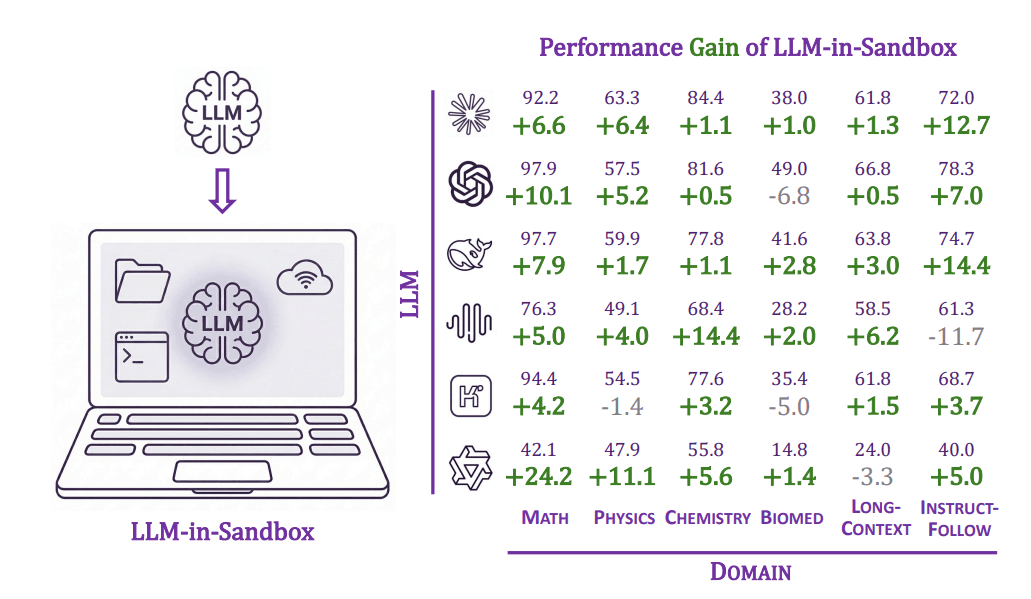
Imagine giving a language model not just a text prompt, but an entire virtual computer to play with. That is the fascinating premise behind LLM-in-Sandbox, a new framework where researchers allowed Large Language Models (LLMs) to explore within a code sandbox to solve non-coding tasks. Let me break this down—instead of just generating text, these models can now execute commands, manage files, and browse the web, effectively acting as agents in a digital environment.
Here is the fascinating part: strong models like Claude-Sonnet-4.5 and GPT-5 didn't just understand the sandbox; they spontaneously used it to solve problems outside of coding. Without any additional training, these models leveraged the sandbox to achieve substantial performance gains across mathematics, physics, chemistry, and biomedicine. For instance, the Qwen3-Coder model saw a massive boost of +24.2% in mathematics tasks simply by utilizing the computational environment. However, it wasn't all smooth sailing. Weaker models, like the Qwen3-4B-Instruct, actually performed worse initially—they tended to "wander" aimlessly without effectively using the tools available.
To fix this, the team introduced LLM-in-Sandbox Reinforcement Learning (LLM-in-Sandbox-RL). This method trained models using only general, non-agentic data to teach them how to explore the sandbox. The results were impressive. After training, the previously struggling Qwen3-4B model significantly improved in biomedicine tasks, jumping from a score of 10.0 to 14.4. Surprisingly, this training also improved the models' performance even when they weren't using the sandbox, suggesting that agentic skills transfer back to standard text generation.
So, how does this actually function under the hood? The "sandbox" is essentially a lightweight virtual computer—specifically an Ubuntu-based system running in a Docker container. It provides the LLM with three fundamental tools: execute_bash for running terminal commands, str_replace_editor for handling files, and a submit function to finish the task. This setup grants the AI three meta-capabilities: accessing external resources (like the internet), managing files for long-term storage, and executing code for computation.
The workflow encourages the model to explore freely. For long-context tasks, instead of forcing a massive document into the text prompt (which gets expensive), the system places the document in a file within the sandbox. The model must then use tools like grep or Python scripts to find the information it needs. This approach mimics how a human researcher might interact with a computer system, rather than just trying to hold everything in "working memory."
The implications for efficiency are significant. Because the sandbox handles data through files rather than stuffing everything into the prompt, LLM-in-Sandbox dramatically reduced token consumption in long-context scenarios by up to 8×—dropping from 100,000 tokens down to just 13,000 tokens in one example. This makes running these models much cheaper and faster.
Beyond just text, this paradigm unlocks cross-modal capabilities. The researchers demonstrated the system generating interactive maps, conference posters, animated videos, and even music compositions by orchestrating specialized software within the sandbox. However, we have to be honest about the limitations. The generated videos were limited to simple 11-second animations, and while the music was structurally correct, it lacked the expressiveness of human composition. Still, the evidence suggests that moving from text-in-text-out to a full computer-in-the-loop is a compelling path toward general artificial intelligence.
LLM-in-Sandbox is a framework that gives large language models access to a virtual computer environment, allowing them to execute bash commands, edit files, and run code. By interacting with this sandbox, models can perform tasks like mathematical calculations, data retrieval, and file management, enabling them to solve complex problems in fields such as math, physics, and biomedicine—even though these tasks aren't directly related to programming.
Weaker models like Qwen3-4B-Instruct initially performed worse because they lacked the ability to effectively navigate and use the tools in the sandbox, often wandering without purpose. Researchers addressed this by introducing LLM-in-Sandbox-RL, a reinforcement learning method that trained these models using general data to develop better exploration and tool-use skills, resulting in significant performance improvements—even beyond sandboxed tasks.
The framework reduces token usage by up to 8× in long-context tasks by storing information in files instead of processing everything through the prompt, making AI inference cheaper and more efficient. It also enables cross-modal outputs like maps, videos, and music by leveraging software within the sandbox. However, current limitations include short, simplistic video generation and music that is structurally correct but lacks emotional depth, highlighting that while the system expands AI capabilities, there is still room for improvement in output quality.
This article has been reviewed by a PhD-qualified expert to ensure scientific accuracy. While AI assists in making complex research accessible, all content is verified for factual correctness before publication.
The AI Hivemind: Why All Chatbots Sound the Same Now
You’ve noticed it too—AI responses are starting to blend together. Here’s why that’s dangerous.
Prompt Repetition Improves Non-Reasoning LLMs Without Added Latency
Repeating the input prompt improves accuracy across Gemini, GPT, Claude, and Deepseek models in 47 out of 70 benchmarks with zero losses and no added latency.
Anthropic's Assistant Axis: How LLM Persona Drift Causes Harmful AI Behavior
Researchers at Anthropic and Oxford identified a linear 'Assistant Axis' in LLM activation space that governs persona stability. Activation capping along this axis reduced harmful responses by nearly 60% without degrading model capabilities.
No comments yet. Be the first to share your thoughts!
Get notified when we publish new articles. No spam, unsubscribe anytime.