Artificial Intelligence
News Reporter
Expert Verified
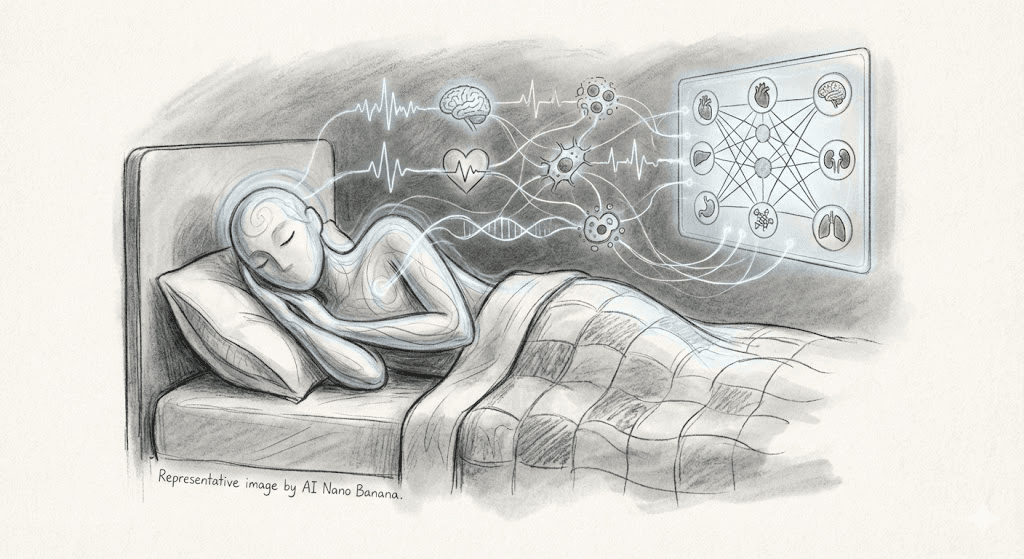
SleepFM AI model trained on 585,000 hours of sleep data predicts 130 diseases including dementia and heart failure from one overnight recording.
Researchers at Stanford University have built the first AI system capable of predicting 130 different diseases from a single night of sleep data, a milestone that could reshape how doctors screen for conditions ranging from dementia to heart failure. The system, called SleepFM, was trained on more than 585,000 hours of overnight sleep recordings from roughly 65,000 participants, making it the largest AI model ever developed for sleep-based disease prediction.
For the first time, an AI system trained on 585,000 hours of sleep recordings can predict 130 diseases from one overnight sleep study. SleepFM predicted dementia with 85% accuracy, death with 84% accuracy, and heart failure with 80% accuracy. The model could eventually complement existing screening tools for millions of patients.
The results, published in 2026 by a team led by Stanford's James Zou and Emmanuel Mignot, are striking in their breadth. SleepFM accurately predicted 130 conditions with at least 75% accuracy (C-Index of 0.75 or higher, with Bonferroni-corrected P values below 0.01).
Among the standout predictions: dementia at 85% accuracy, all-cause mortality at 84%, heart attack at 81%, heart failure at 80%, chronic kidney disease at 79%, stroke at 78%, and atrial fibrillation at 78%. The model also showed strong results for Alzheimer's disease (91% C-Index), Parkinson's disease (89%), and several cancers, including prostate cancer (90%) and breast cancer (90%).
These predictions come from a single overnight sleep study, the kind already conducted in clinics worldwide.
SleepFM works by analyzing the multiple signals captured during a standard overnight sleep study: brain waves, heart rhythms, muscle activity, and breathing patterns. The AI was trained using a self-supervised learning approach, meaning it learned patterns from raw, unlabeled data rather than relying on doctors to manually tag each recording.
The model's architecture is designed to handle variations in how sleep studies are conducted at different clinics, including differences in which sensors are used and how many channels are recorded. This flexibility is critical for real-world use, where no two sleep labs operate identically.
When tested on the Sleep Heart Health Study, a dataset the model had never seen during training, SleepFM maintained strong performance. It predicted stroke at 82% accuracy, congestive heart failure at 85%, and cardiovascular death at 88%, demonstrating that its predictions transfer across different patient populations and clinical sites.
The researchers also found that SleepFM outperformed both a demographics-only model (using age, sex, race, and BMI) and a supervised model trained directly on raw sleep data without pretraining, by 5% to 17% in accuracy across disease categories.
The researchers were candid about important caveats. The training data came primarily from patients referred to sleep clinics because of suspected sleep problems, meaning the dataset does not represent the general population. People without sleep complaints or without access to specialized clinics were underrepresented.
Model performance showed some decline when tested on data from different time periods, highlighting the challenge of maintaining accuracy as clinical practices evolve. The researchers also acknowledged that understanding exactly which sleep patterns drive specific disease predictions remains difficult given the complexity of the AI model.
Related developments in wearable sleep technology could eventually bring models like SleepFM closer to everyday health monitoring. The team suggested that future research should explore combining sleep-based AI with electronic health records, genetic data, and medical imaging to further enhance predictive power.
Yes. According to the 2026 study from Stanford University, SleepFM is the first foundation model to systematically evaluate sleep's predictive power across 1,041 disease categories. It accurately predicted 130 conditions with at least 75% accuracy from one night of polysomnography data. Previous models focused on individual outcomes and used far smaller datasets.
The researchers suggest SleepFM could complement existing risk assessment tools for patients already undergoing overnight sleep studies. The model showed strong results for cardiovascular conditions, neurodegenerative diseases like Alzheimer's and Parkinson's, and several cancers. As wearable sleep technology advances, the researchers note that models like SleepFM may eventually enable noninvasive, real-time health monitoring for broader populations.
The researchers identified several key limitations. The training data came primarily from patients referred to sleep clinics for suspected disorders, so results may not generalize to the broader population. Performance declined somewhat on data from different time periods. Additionally, the model's predictions are difficult to interpret at the individual case level, and only a subset of the 130 predicted conditions could be validated on external datasets due to limited diagnostic overlap between cohorts.
This article has been reviewed by a PhD-qualified expert to ensure scientific accuracy. While AI assists in making complex research accessible, all content is verified for factual correctness before publication.
The AI Hivemind: Why All Chatbots Sound the Same Now
You’ve noticed it too—AI responses are starting to blend together. Here’s why that’s dangerous.
Prompt Repetition Improves Non-Reasoning LLMs Without Added Latency
Repeating the input prompt improves accuracy across Gemini, GPT, Claude, and Deepseek models in 47 out of 70 benchmarks with zero losses and no added latency.
Anthropic's Assistant Axis: How LLM Persona Drift Causes Harmful AI Behavior
Researchers at Anthropic and Oxford identified a linear 'Assistant Axis' in LLM activation space that governs persona stability. Activation capping along this axis reduced harmful responses by nearly 60% without degrading model capabilities.
No comments yet. Be the first to share your thoughts!
Get notified when we publish new articles. No spam, unsubscribe anytime.