Artificial Intelligence
Explain Like I'm 5
Expert Verified
Scientists gave AI a virtual computer playground. Now the AI can do math, read huge books, and even make music all by itself!
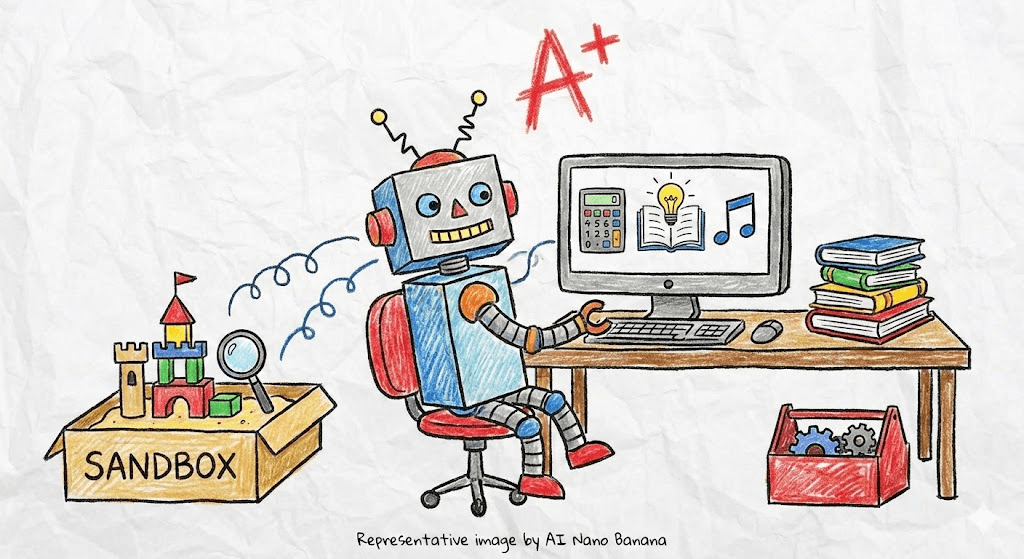
Imagine if you had a robot friend that was really good at reading stories, but didn't know how to use a calculator or draw a picture. What do you think would happen if you gave that robot a real computer to play with? Scientists tried this exact experiment, and guess what? The robot suddenly became super smart! It learned how to solve math problems, read giant books, and even create music all on its own. Isn't that cool?
Scientists call this special experiment "LLM-in-Sandbox." A sandbox is just a fancy name for a safe, digital playground or a virtual computer. Usually, computer brains, called Large Language Models or LLMs, just read and write text. But in this sandbox, they can use tools like we do! They can search the internet, save files, and run little programs. The amazing part is that the scientists didn't even teach them how to use these tools. The smartest AIs just figured it out! They saw a hard math problem and decided to write a code to calculate the answer all by themselves. It’s like giving a child a toolbox and watching them build a castle without any instructions.
This digital playground helps the AI in some big ways. For example, when the AI used the computer to help with math, one model got 24.2% better at solving problems! That is a huge jump. It also helps them read super long stories without getting a tummy ache. Usually, reading a giant book uses a lot of the computer's "brain energy" (tokens). But with the sandbox, the AI saves the book as a file instead of trying to memorize it all at once. This cut the energy needed by up to 8 times! That’s like shrinking a giant pile of toys into a tiny box you can hold in your hand. Plus, this whole playground is very light—it only takes up about 1.1 GB of space, which is tiny for a computer.
Some smaller AIs were a little confused at first and just wandered around the playground without doing much work. So, scientists invented a fun game called "LLM-in-Sandbox-RL" to teach them. It’s like giving a gold star when the AI finds the right tool. This training helped the confused AIs get super smart, too! Now, scientists are excited about the future. With these virtual computers, AIs can do more than just write words. They can make birthday videos, draw colorful maps, write songs, and design posters. They are turning from readers into real digital creators, and we can't wait to see what they make next!
LLM-in-Sandbox is an experimental setup where large language models (LLMs) are given access to a virtual computer, like a digital playground, to interact with tools and software. This allows the AI to perform tasks beyond just reading and writing text, such as solving math problems by writing code, saving files, and searching the internet. The AI figures out how to use these tools on its own, significantly boosting its problem-solving abilities without direct human instruction.
With access to the sandbox, AI models improved by 24.2% in solving math problems by generating and running code to find answers. For reading, the sandbox allows the AI to save long texts as files instead of processing everything at once, reducing the 'brain energy' (tokens) needed by up to 8 times. This makes handling large documents much more efficient and less taxing on the system.
Equipped with a virtual computer, AIs can evolve from simple text generators into digital creators capable of making birthday videos, drawing maps, composing music, and designing posters. To help less advanced AIs learn faster, scientists created a reinforcement learning game called LLM-in-Sandbox-RL, which rewards effective tool use. This training unlocks creative potential, turning AI into a versatile assistant for complex, real-world tasks.
This article has been reviewed by a PhD-qualified expert to ensure scientific accuracy. While AI assists in making complex research accessible, all content is verified for factual correctness before publication.
The AI Hivemind: Why All Chatbots Sound the Same Now
You’ve noticed it too—AI responses are starting to blend together. Here’s why that’s dangerous.
Prompt Repetition Improves Non-Reasoning LLMs Without Added Latency
Repeating the input prompt improves accuracy across Gemini, GPT, Claude, and Deepseek models in 47 out of 70 benchmarks with zero losses and no added latency.
Anthropic's Assistant Axis: How LLM Persona Drift Causes Harmful AI Behavior
Researchers at Anthropic and Oxford identified a linear 'Assistant Axis' in LLM activation space that governs persona stability. Activation capping along this axis reduced harmful responses by nearly 60% without degrading model capabilities.
No comments yet. Be the first to share your thoughts!
Get notified when we publish new articles. No spam, unsubscribe anytime.