Climate & Environment
Podcast Host
Expert Verified
We're Closer to Climate Tipping Points Than We Thought
3 min read
Even 1.1°C of warming may have already nudged us into danger zones. Here’s what could collapse next.
Hello everyone!
Let me tell you something — I do not want to scare you or anything but, this paper hit me like a fridge door in a hot kitchen. You know that moment when you open the fridge, expecting relief, but it’s just... lukewarm? That’s kind of where we are with climate change. We thought we had more time, but turns out, we might already be past the point of no return on some systems.
Think of it like this: you’re leaning back in your office chair. At first, it’s stable. But there’s one angle — just a few degrees too far — where suddenly, you’re falling. And once you start tipping? You’re going down. No stopping it.
That’s what we’re talking about with climate tipping points. These are thresholds where a part of the Earth’s system shifts into a new state — self-perpetuating, unstoppable, and often irreversible.
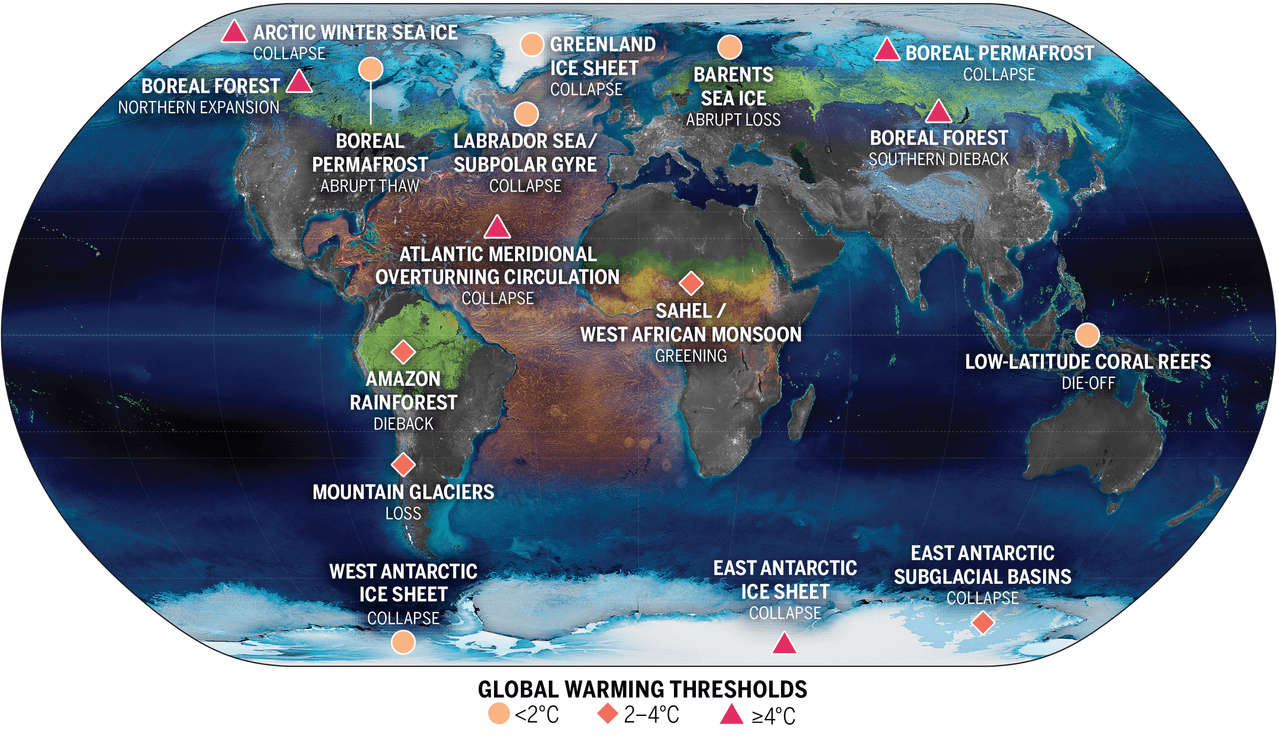
We’re already at ~1.1°C of warming since pre-industrial times. And guess what? That’s not below the danger zone — it’s inside it. For at least five tipping elements, 1.1°C is already within the lower range of their tipping threshold.
Like, we’re not just knocking on the door. We’ve stepped one foot inside.
The scientists identified nine global core tipping elements — the big ones that keep the planet stable. These aren’t just local problems; they affect the whole Earth system.
Greenland Ice Sheet collapse → meters of sea level rise
West Antarctic Ice Sheet — oh man, you won’t believe this — some parts may have already passed their tipping point
Atlantic Meridional Overturning Circulation (that’s the Gulf Stream system) slowing down
Amazon rainforest dieback from drought and deforestation
Permafrost thaw releasing massive amounts of methane
And here’s the thing: these aren't “if.” It’s “when” — and the when might be sooner than we thought.
We’ve been told that 1.5°C is the “safe” limit. The Paris Agreement target. But this study says: nope, that’s not safe at all.
Between 1.5°C and 2°C? At least six tipping points become likely — including ice sheet collapse and coral reef die-offs. And under current policies? We’re on track for 2 to 3°C. That’s not a typo. That’s a full-blown system meltdown.
And it gets worse: crossing one tipping point can trigger others. It’s a domino effect. Thawing permafrost warms the planet more, which stresses the Amazon, which releases more carbon, which melts more ice. Positive feedbacks — but they’re anything but positive.
I know this sounds bleak. And honestly? It is. But here’s the light in the dark: we still have agency.
We need:
Faster emissions cuts (obviously)
Early warning systems using AI and satellite data
Better models to predict tipping behaviors
Policies that treat tipping points as urgent risks
We’re not doomed — but we are out of time for slow motion.
So here’s my challenge to you: next time someone says, “We’ve got decades to fix this,” tell them about the West Antarctic ice sheet. Tell them we might already be in freefall.
And then? Let’s push harder.
This article has been reviewed by a PhD-qualified expert to ensure scientific accuracy. While AI assists in making complex research accessible, all content is verified for factual correctness before publication.
clumsy_scientist
Jan 4, 2026
Now I wonder how long it will take to reach the tipping point for all. This seems to be getting worse without us knowing it.
Get notified when we publish new articles. No spam, unsubscribe anytime.